Emerson Research Paper

Thomas Mazzaferro

Professor Engel

American Renaissance

25 February 2019

Balance of Our Being


In his essay, “Self-Reliance,” Ralph Waldo Emerson believes that true happiness and enlightenment will come to those who trust only themselves and their intuition. He argues that imitating others or the past will only result in a complete death of originality. However, can undeniable self reliance really exist in our society? At what point in our early lives can we become independent beings, and no longer rely on parental support? Are we able to be educated without the assistance of others? I believe it is impossible for someone to be completely self-reliant in our world. Throughout our early lives and childhood, we are reliant on our caretakers. In education, we rely on our mentors to teach us. Even whole generations are reliant on the era that came before theirs. In the following essay, I will break down how self-reliance is impossible within childhood, education, and society.  

In order to grow and learn, we mimic our surroundings from a young age. The only way we are able to learn to speak, eat, and behave is based on the actions of those around us. When we are all infants, we rely on the world to teach us how to live within it. Even as we grow older, there are many aspects of life that would be impossible without some reliance on others, especially parents or guardians. Emerson states, “I suppose no man can violate his nature. All the sallies of his will are rounded in by the law of his being…”(113). This “law of being” mentioned describes the intrinsic rules that rest within each of our subconscious minds. Social norms and unspoken laws of society keep us all from straying too far from civilized life. I believe this is a clear contradiction to Emerson’s main ideas. Whether we deny it or not, we are all reliant on these social norms we were commanded to follow as children. Could a person deny the fact that they have to wear clothes, and claim themselves to be totally self-reliant, as they reject the social norm of being dressed? Emerson clearly does not wish for our species to evolve into separated, naked outcasts, and I speculate that he realized we cannot fully deny these rules. We must imitate to some extent, in order to live normal and healthy lives. He even later states, “We pass for what we are. Character teaches above our wills”(113). The true inner self we have subconsciously been molded into will always prevail over whoever we desire to be.

Another aspect of life in which I believe self-reliance to be impossible is education. We are completely incapable of pursuing any knowledge without the assistance of others. Even when reading a book alone in one’s room, we are still relying on the author to lay his knowledge out on the pages before us. In fact, it occurred to me that I was relying on Emerson to explain to me how to no longer rely on others. His essay itself may be self-reliant, written entirely from Emerson’s own thoughts and beliefs, but as readers and students, we rely on his writing in order to understand this concept. Emerson famously claims that “There is a time in every man’s education when he arrives at the conclusion that envy is ignorance; that imitation is suicide”(110). He believes that true knowledge comes from the honest work of a man producing original thought. Although I understand his desire for individuality, I cannot agree with this quote. This quote denounces imitation and envy, which both can serve as a powerful driving force for a young writer. We envy our idols and long to be as perfect as they seem to be. Imitating the work of others can in fact lead to mindless copying, but without the ability to build on the work of others, we may have not gotten this far as a species. I believe finding just the right amount of imitation and envy in one’s work will have no negative impact on originality.

Society will always undergo great change, just as it did throughout Emerson’s time and ours. He relates society to a wave, although it will always be made up of water, it crashes on the shore in a different way every time. He explains this metaphor, “The persons who make up a nation to-day, next year die, and their experience dies with them”(120). This “experience” he speaks on are the ways in which this person has changed society. Emerson believes that this endless change in society is a direct result of the self-reliance held by the powerful and intelligent people of each generation. Their unique thoughts and beliefs are accepted by their society, until the wave recedes and those values die out and are replaced. In my opinion, human beings have built upon the past since the beginning of time. The Vietnam generation greatly opposed the war, not because of some sporadic thought, but in response to past mistakes and memories of terrible conflict. Each generation has taken what they want from the last, and improved their own “wave,” until the next “wave” can improve them further. We are reliant on the mistakes of the past and the lessons our ancestors learned the hard way.

Total self-reliance seems to be a far-fetched concept. As much as I find myself disagreeing with him, I still believe Emerson to be very correct in much of his essay. He is not asking us to completely deny social norms, forget past generations and ensure we live differently from every single person around us. However, he asks us to find self reliance in our lives, whenever we can. Perhaps self-reliance is not meant to be absolute. We should find the greatest balance we can, never rely too much on the outer, and never too much on the inner. Emerson states, “It is easy to see that a greater self-reliance must work a revolution in all the offices and relations of men; in their education; in their pursuits; their modes of living; their association; in their property; in their speculative views”(117). Emerson is asking us to attempt to find individuality within each aspect of our lives. He longs for Americans to question, to deny, and to change. True individuality and a unique state of being will be found through balance. Find that balance and stay true to thyself, consider the thoughts of others, and live to be you. 

Works Cited

Emerson, Ralph Waldo. “Self-Reliance.” Nation of Letters: A Concise Anthology of American Literature. Volume 1. Second Edition. Edited by Cushman, Stephen and Paul Newlin. Brandywine Press. 1998. 2005. Pages 110-120.

Chaucer Research Paper

Thomas Mazzaferro

Professor Pritchett

Chaucer and the Medieval Period

14 December, 2018

The Power of Sovereignty


The Canterbury Tales is a collection of stories told from many perspectives of the Middle Ages. The Tales reveal so much about, not only the time period in which they take place, but the types of people telling these stories. Geoffrey Chaucer makes use of satire through this process. His characters unknowingly reveal their true colors, opinions, and beliefs when they share their stories. These tales often have very distorted messages, unclear morality, and strange endings. Through these Tales, Chaucer indirectly criticizes various aspects of Medieval life, through the voices of those he targets. However, not every aspect of Medieval life Chaucer pointed out was in a satirical fashion. Chaucer also wanted to expose what he believed was wrong with the society he lived in. Through “The Wife of Bath’s Tale” Chaucer is able to give women the equality and strength they deserve to overcome the iron grip men hold on their lives. Through this Tale, Chaucer’s beliefs on gender inequality shine greatly.

In “The Wife of Bath’s Tale,” a lusty young Knight is put on trial for recently raping a woman. This is no ordinary trial, as he is sat before the Queen and her court of noble ladies. The women are the ones who will decide his fate, and nothing is looking in the Knight’s favor. The court presents the Knight with an ultimatum; he must answer the question before him, or be sentenced to death. The question he is asked is “What do women desire most in the world?” After struggling for days to find an answer, it is eventually given to him by an older ugly woman he meets in the woods. Apparently, what women desire most in the world is “sovereynetee.” Sovereignty is defined as “control” or “absolute dominion.” Therefore, the wyf is stating that women desire control over men, and not the other way around. The Knight presents this answer to the Queen and his life is spared, however the old woman requests that the Knight marry her as payment for her aid. At the end of the story, the wyf asks the Knight if he wishes for her to be beautiful or faithful, he allows her to make the decision for herself. In this moment, the wyf decides the Knight has learned his lesson, and transforms herself into a beautiful young woman.

The “happily ever after” ending to “The Wife of Bath’s Tale” has left many critics skeptical. There are many concerns with this Tale, however the wyf’s quick decision to forgive and forget is the most prominent. In her scholarly essay titled “The Problem of Defining ‘Sovereynetee’,” the critic Susanne Sara Thomas argues that the Knight has not learned his lesson, and the wyf is simply foolish for believing so. Susanne Thomas believes that the wyf is failing to uphold her sovereignty, as the Knight is still indirectly deciding her physical form. This Knight was known as lustful and raped a beautiful young woman at the beginning of the story. His desires and motivations in life are clear, he wants a beautiful young wife. 

Therefore, Thomas argues that the wyf is simply conforming to his desires when she transforms into this young woman, rather than her natural older form, which the Knight has decided is not what he wants. Thomas even explains in her essay, “The opposite of ‘sovereynetee’ the state of non-authority and non-mastery, occurs when one allows others to define for one what is desirable and valuable.” (Thomas 89) By stating that he is sad about his new ugly wife, the Knight is defining for the wyf what is truly desirable and valuable. His action of letting her decide her appearance does not matter as he has already expressed what he does not want her to be. She chooses to conform to the physical state that he would enjoy the most, so her sovereignty does not hold true.

Susanne Thomas’s argument is very acceptable because of the nature of the ending to this Tale. It is confusing, strange and unrealistic that someone as wicked as a rapist is completely forgiven, and even rewarded in the end. How is this woman displaying her control, if she is simply asking the Knight how he wants her to look? He may let her decide, but in the end she is still choosing the option he would enjoy the most. In another scholarly essay, Anne McTaggart wrestles with the Knight’s unchanging character. She states “…even after spending all that time asking women how they feel and what they desire, the newlywed Knight is led to the bedchamber no less concerned with his own needs and desires…” (54) It is clear that the rapist Knight is a static character that fails to learn any lessons, and is simply trying to make the best out of the fate he has been given.

Once it is understood that the Knight is an unlearning, unchanging character, one must find their own interpretation of the wyf’s lesson. In disagreement with Thomas and McTaggart, one could argue that the wyf is actually in more control than the average reader thinks. The wyf first displays her sovereignty as she hangs the answer over the Knight’s head. She is one of his last options as the day of his death approaches, so he is forced to rely on her here. Prior to this, the only sovereign woman in the Tale was clearly the Queen, who has the power to decide whether this Knight lives or dies. However, sovereignty is defined as “complete control” and “absolute or supreme dominion,” and the wyf actually goes on to carry out this definition better than any other character in the Tale. One of the most striking and interesting parts of this story is that the wyf has the inherent ability to shape shift. She can alter her form between an ugly old woman, and a beautiful young girl. One could argue that this is where she displays her absolute and undeniable sovereignty. As Thomas argues, the Knight has defined what is desirable to him, and the wyf must now conform to it. However, it is the wyf’s ability to conform that gives her this control over him. She has the option to decide how desirable she may be to him, and to the extent of the reader’s knowledge, she is capable of transforming at any moment. The wyf has simply allowed the Knight to show her what he finds desirable, and she is able to use that as her bait at any time. The moment this Knight fails to be an honorable husband, the wyf could potentially transform back to ugly undesirable state, thus leaving him miserable once again. She holds a complete control over their marriage and the passion he has for her, all through her appearance. This is the definition of sovereignty, and it is not displayed at this level by any other character. Although the Queen is capable of deciding life or death, the wyf is capable of altering reality in her favor. She holds a supreme power above all other women in the Tale, and holds absolute sovereignty over every aspect of her marriage. 

This story can give us great insight into the beliefs and desires of the Wife of Bath. As this story is meant to come from her, there is much we can infer about her fantasies when it comes to men. She wishes to have this control over any type of man, great or evil. She longs to flip a switch and become desirable to anyone she wants. As we learned from her prologue, she has been with quite a few men and is growing older and less desirable. Chaucer could have written this story to convey the message that women have more control over men than most would believe. The men of The Canterbury Tales are instinctual, selfish, and animalistic at times. This story displays the downfall of man, and paints women in a light of superior intelligence and morality. It is an incredibly interesting look back on the path of gender equality and a glance into Chaucer’s opinions on marriage. The power struggle between the Knight and the wyf is a clear sign that sovereignty was truly prominent in marriages of the time, either from men or women, and romantic love was surely far from present.

Works Cited

McTaggart, Anne. “What Women Want? Mimesis and Gender in Chaucer’s ‘Wife of Bath’s Prologue’ and ‘Tale.’” Contagion: Journal of Violence, Mimesis, and Culture, vol. 19, 2012, pp. 41–67.

Thomas, Susanne Sara. “The Problem of Defining Sovereynetee in the Wife of Bath’s Tale.” The Chaucer Review, vol. 41 no. 1, 2006, pp. 87-97. Project MUSE

Shakespeare Research Paper

Thomas Mazzaferro

Professor Doyle

Shakespeare Final Paper

10 December 2018

Shakespeare Reveals Himself


Literature is an incredibly powerful form of media. We, as the readers, are able to step out of our reality and into the text. The text can take us to other places, worlds, and into the lives of people and beings we have never met. Fiction is a genre that rejects the limits and laws of reality, to take it’s reader somewhere they would never be able to find otherwise. It is through the process of reading that we can escape our own individual world and peek into another. However, how do these worlds come to be? Are human beings truly capable of creating their own worlds, simply from the words they put on paper? The answer lies in the process of creating fiction, and all fingers point towards the author. The author is the divine, omnipotent creator of these worlds, they design the reality, laws, conflict, and messages behind the story. However, in order for humans to create reality, they must gather what they have learned about the world, from the life around them. Here is where an interesting event happens, the author begins to, potentially unknowingly, pour their own life and knowledge into the world they have created for us. Scientist work within a field they focus on, Musicians make music pertaining to their personal genre, Writers of fiction make use of their knowledge of reality, in order to copy or replicate it. The author must take bits and pieces of our known and understood world, in order to translate this unknown and confusing one for us. Here, many issues can arise, as an author’s understanding of the world will surely shine through their work, and can reveal a great deal about who they were as a person, and the world they lived in.

William Shakespeare is obviously a widely beloved author of fiction, and creator of many worlds. He would often make use of real-world locations, and place his fictional characters within them. Shakespeare lived in Europe and was constantly surrounded by European people, culture, history and more. He was relatively unexposed to the outside world. So, one could argue that Shakespeare had a certain amount of limitations on the things he could effectively write about. The man would very often write about other nations and countries, but they would be very European, even his fictional settings had very European structure to them. In his essay on “Culture” Stephen Greenblatt writes “a careful reading of a work of literature will lead to a heightened understanding of the culture within which it was produced.” (227.) According to Greenblatt, an author is only capable of writing what their culture knows. Author’s are incapable of setting their own world aside, at some point in the writing process, their own thoughts, beliefs, morals and understandings will bleed into their text. So, what can we learn about early European culture, by analyzing moments in which Shakespeare expressed thoughts on Culture, Gender and Race through his fictional plays.

It is easy to see European culture through the concept of social hierarchy, which come into play in many of Shakespeare’s works. One’s status and class in society was very important in Shakespeare’s time, and these characters are often very important to the story. However, there is one character in a very lowly place, who still holds great importance. In A Midsummer Night’s Dream the character of Bottom is mainly seen as comic relief, to keep the driving force of comedy and mischief prominent throughout the play. Bottom is a young actor who seems very hopeless and sad. He lacks any noble place in society and is meant to be seen as below the majority of the characters. However, Bottom’s place in society is a interesting factor of his importance to the story. Later in the play, Bottom’s head is transformed to that of a donkey’s, through the magic of the fairies in the forest. The Queen of these fairies Titania, quickly falls in love with the donkey-headed Bottom as a result of a love potion affecting her. This event is a very powerful moment in the play as Titania could be considered to be one of the highest social positions in the entire play. She is not only a Queen, but also Queen of the Fairies, a species of beings that clearly holds a great power over the rest of the human characters. Her affection for the lowly Bottom could be seen as Shakespeare revealing a satirical view he had of his society. His culture was so greatly focused on wealth, status and social position, so Shakespeare chose to depict these two characters, of opposite worth, intimately in love and affectionate with each other. This occurrence would be so incredibly ridiculous to his audience, that it would be seen as comedy. In today’s society, these kinds of relationships are quite common. At least in the United States, social position does not play nearly as large a part in marriage as romantic love does. So, through this scene, Shakespeare’s early European culture reveals its belief that being in love with someone outside of one’s own social position was frowned upon, and even worthy of mockery.  

Many of the plays we have come to know and love could be vastly different if Shakespeare’s life was even slightly changed. One of the many aspects of Shakespeare’s life that influenced his writing was his Gender. If Shakespeare was a woman instead, many events of his plays would play out differently. This is all purely speculation, however, one could argue that a female playwright would work harder to emphasize the unbalance between men and women in this time period. As another example from A Midsummer Night’s Dream, the character of the Duke Theseus holds an interesting power over his daughter’s head. Hermia, daughter of the Duke, is deeply in love with a man named Lysander. However, her father longs for her only to marry another man known as Demetrius. Theseus forbids his daughter from marrying Lysander and Hermia must find a way to accept this fact. Hermia attempts to reconcile with her Father and explain that they are both great men, but she loves Lysander more. Theseus responds, “But in this kind, wanting your Father’s voice, the other must be held the worthier.”(5) This is simply Theseus stating, “Yes, but my opinion matters more.” Although Hermia struggles with this conflict, there is more of a focus on the fact that she is forbidden from marrying specifically Lysander. There is significantly less of a focus on the fact that her Father gets to determine who she marries. In my opinion, a female Shakespeare would allow this issue to come to light much more. A female Shakespeare would hope to make use of these characters to expose the falsities of this cultural phenomenon. Being a women themselves, they would sympathize with Hermia much more, and attempt to spark a sense of freedom in the women of the time, and push them to make decisions for themselves. Instead, Shakespeare uses this conflict as a source of comedy and confusion, rather than expose the corrupt and oppressive side of the society he lived in.

Race was most likely Shakespeare’s most close-minded subject. There is no greater evidence that his own society greatly influenced his work. Throughout early European culture, there is a powerful and consistent use of the term “White privilege.” This privilege was the belief that white people are above all other races, in intelligence, culture, and technology. Much of early European culture was based upon the “White Man’s Burden” the belief that white settlers must further expand lesser developed nations and modernize them. However, as issues like racism and slavery arose, the “White Man’s Burden” was a complete failure. One character of Shakespeare’s plays is a living representation of this failure to aid the lesser developed world. In Shakespeare’s famous play The Tempest, the character Prospero lives on a deserted island in the middle of the ocean. Prospero is often depicted as an elderly white-skinned wizard who is very intelligent and clever. When arriving on the island, Prospero meets Caliban, a native “creature” that has already lived on the island for some time. Caliban is described as a dark, evil beast that crawls around and acts like an animal. The play greatly antagonizes him, and the many white European characters have a passionate hatred for Caliban. However, Prospero has an interesting relationship with him. Caliban acts as a sort of servant to Prospero, much like a slave. The wizard is clearly above him in intelligence and strength, and the native Caliban had no choice but to give in to Prospero’s conquest of the island. This aspect of The Tempest is an incredibly clear depiction of the European expansion to the New World. The fact that Caliban, who technically should rule the land he was born on, is pushed aside by the oppressive White European characters, is like Shakespeare giving us a fictional play-by-play of how British colonization went. In order for Caliban to be seen in a different light, Shakespeare would have to have been born into a culture much more negatively affected by colonization. Because of his society, he saw no wrong in the actions of his fictional characters, and thoughtlessly wrote off Caliban as a mindless, villainous animal. 

This is not an attempt to expose Shakespeare as some ugly label like racist or sexist, but rather an example of the fact that the world an author lives in greatly influences what they write about, and how they write about it. We, as humans, are natural learners. We gather information about the things around us and cement them into our minds, especially as we are growing up. It is difficult to break away from one’s conditioning, or natural programming society places upon each one of us. As modern writers, we must find a way to deny our own world, and find a way to create wholly new realities, never based on our own opinions or mindsets. Otherwise, bias, stereotype, racism and unbalance will continue to exist in the world. Literature often has the ability to outlive the society it came from, so let’s make sure our society is looked back on with a positive glance.

Works Cited

Greenblatt, Stephen. “Culture.” Critical Terms for Literary Study. Edited by Frank Lentricchia and Thomas McLaughlin. Second Edition. 1995.

Shakespeare, William. A Midsummer Night’s Dream. The Pelican. Edited by Russ McDonald. New York 2016.

Senior Thesis Symposium Presentation

Thomas Mazzaferro

Professor Robinette

Senior Seminar Capstone

29 April, 2019

The Theme of Madness in Edgar Allan Poe’s “The Fall of the House of Usher”


In his short story “The Fall of the House of Usher,” Edgar Allan Poe utilizes the theme of madness by injecting it into every literary device working in his short fiction. Madness creeps into every aspect of the story such as settings, characters and the narrative. In 

doing so, Poe creates an atmosphere of madness, in which all literary devices and objects are affected by complete degradation. I believe this injection of madness is Poe’s most powerful tool, which renders him a master of storytelling, imagery, and foreshadowing. In the following, I will discuss the many ways in which Poe makes use of this atmosphere of madness in order to strengthen elements of the story, foreshadow its ending, and perhaps show us his own sense of the world.

Throughout “House of Usher” countless objects, characters and settings are intimately connected to the story’s bleak mood of instability and decay. It is as if Poe is applying a mental state to the entire story as a whole. Each and every element reflects the overarching mood, so that no matter where the reader turns, they cannot escape Poe’s atmosphere. This theme of madness is global, inescapable, and has contaminated the entirety of the story. Through this complete contamination, the readers themselves are exposed to the workings of an ill mind, finding no solace or alleviation from madness, it is everywhere.

The mental landscape was an essential tool in Poe’s process of writing fiction. The “mental landscape” is a device Poe uses, in which the setting, or landscape, reflects the mood of the story and characters. As he states in his essay titled, “House of Mirrors: Edgar Allan Poe’s ’The Fall of the House of Usher,” John H. Timmerman signifies the connection between the appearance of a place, and human emotions. As Timmerman and other scholars have noticed, there often appears a “close interconnectedness between the physical and psychological, the external environment and the internal mind” within Poe’s fiction (164). In other words, when it comes to literary devices being the driving force of his fiction, Poe’s settings are the most prominent. The setting reflects the feelings of the characters, which reflect the premises of the storyline. Timmerman refers to these devices as “mirror images” (163). These images all reflect one another in order to contribute to one sole meaning or symbol. 

As much of Poe’s short fiction begins by painting a distinct setting for us, potential meanings and overall tones of a piece can be identified from the first descriptions of setting. In “House of Usher” Poe hints at the mansion’s destruction in the very first sentence of the story. “During the whole of a dull, dark and soundless day in the autumn of the year…within view of the melancholy House of Usher” (117). Poe immediately identifies the hopeless “melancholy” of the mansion along with the season of the year. As autumn is a time of decay and death, this story truly describes the Fall coming to the House of Usher. The trees surrounding the house are bare and dead, the “leaden-hued” sky is gray and dull, and “the shades of the evening drew on” (117). I found this to be a crucial mirror image within this story, although Timmerman himself does not shed any light on the significance of the autumn season. All of these aspects of the landscape that surround the mansion are tropes of a day in Autumn, all life and health has shriveled up and died. The season of destruction has arrived, and so too will the physical fall of the mansion, it’s inhabitants, and of course, the Usher family name as well.  

In Madness and Civilization, Michel Foucault criticizes Gothic literature’s use of madness within its imagery. Foucault argues that images in Gothic literature fail “to teach anything but their own fantastic presence” (18). In other words, Foucault believes the symbolic imagery used in Gothic literature never states anything about madness and how it works, but rather only exists to give the reader some glimpse of the mental discomfort madmen feel; to fascinate us rather than to educate. I also believe these images exist to give the reader a peek into how the insane mind processes imagery, however I disagree with Foucault’s claim that these images state nothing about how madness works. It is the sheer amount of images, like the decaying trees, the crack in the mansion, the color of the sky, that truly speaks to how madness works. The narrator is completely overwhelmed not by his physical surroundings, but the uncomfortable emotions that they ignite within him. 

This is what truly defines madness in my opinion, the ability to gain some kind of debilitating mental state from a physical inanimate object, all within one’s own head. Foucault himself even states, “In a general way, then, madness is not linked to the world and it’s subterranean forms, but rather to man, to his weaknesses, dreams, and illusions” (26). Here, Foucault is stating that madness is displayed, not in the physical images themselves, but the imaginary and delusional conclusions a madman can draw from them. Madness is sensitive and inescapable, as it infects one’s perception and how they sense the world, their thoughts become distorted and morals are blurred. 

For example, Roderick Usher describes the mansion’s power over his mental state as “an effect which the physique of the gray walls and turrets, and of the dim tarn into which they all looked down, had, at length, brought about upon the morale of his existence” (123). Here, Roderick confirms that the architecture has some effect on him, but it is his mentioning of the tarn that is most interesting. Each time this tarn is mentioned in the story, there is always an interest in the lakes reflective properties. The House of Usher is perfectly mirrored within this lake in front of it. Roderick is clearly attributing this reflective lake to his illness, and the reflection could potentially be working as an actual and literal mirror for him. Through this lake, he is able to see his own home, which he has not left in years. Roderick Usher is able to see into his own life from the reflection, the exterior, and is constantly reminded of the miserable place he is encapsulated in. He is able to see, as the narrator in the first pages sees, the many aspects of setting that contribute to his torturous existence. 

Insanity can be related to running in circles. Those who are affected often experience fixations, obsessions, and feel intense fear or anxiety at any slight deviation from their expected schedule or lifestyle. The insane mind is one that encases itself, to the point where any outside influences could be considered harmful and promote the mind’s complete collapse. 

After reading the letter Roderick sends him before the story begins, the narrator briefly shares with us his knowledge on the history of the Usher family. From this letter, he learns “that the stem of the Usher race, all time honored as it was, had put forth, at no period, any enduring branch”(119). In other words, the family has rarely bred with any outside influences in the past centuries. They are enclosed within barriers, and this isolated mindset carries onto their two sole heirs to the mansion, Roderick and Madeline. The two descendants do not leave the House of Usher, and rarely interact with anyone outside of it. The reclusive lifestyle of it’s inhabitants, the physical condition of it’s interior, and the isolated history of it’s family all closely relate to the mental illness which hangs over this mansion. As an insane mind becomes lost within itself, so does the Usher family. The many years of inbreeding have led their family tree to a singular, ending branch. 

In Madness and Civilization, Foucault claims that “self-attachment is the first sign of madness”(26). I believe the mainly inbred Usher family is a perfect example of this self-absorption that sparks madness. Roderick’s life of complete isolation has rendered him terrified of any world outside the safety of his home. This is everything he knows, he was raised to reject the outside. He has been completely entrapped in the ideology of his ancestors. As Foucault continues he states, “it is because man is attached to himself that he accepts error as truth, lies as reality”(26). Roderick is a product of his family history, it governs his perception and sense of the world, just as the madness within him does. 

We can infer that Roderick begins to become aware of his mental state, and the isolated life he has led all this time, at some point before the story begins. Otherwise, he would never have invited the narrator to the mansion and would continue his lonely days. When Roderick reflects on his life, he feels great sorrow and anxiety, due to the fact that he is the final link on the Usher chain. As a result of his family’s deep-seated history of isolation, Roderick is convinced that this is his sole destiny, he lacks any motivation to alter fate. This shows the intensity of the madness his family has ingrained within his mind, he is essentially programmed to live in this certain way. 

As Foucault described, lies have become reality and errors are truth, Roderick has totally accepted his fate as the final Usher, following the imaginary laws of his long passed ancestors. A madman is unable to reflect on himself properly, he is unable to deviate from the usual processes of his mind. This process of reflection within madness is what is truly killing Roderick Usher in this story. Foucault even adds, “Madness deals not so much with truth and the world, as with man and whatever truth about himself he is able to perceive”(27). Therefore, Roderick will never truly be able to see himself from the outside, as the only truth he knows is error. He believes the long line of self-attached Ushers that came before him will not allow it, when in reality these dead ancestors have no say in his individual life, but he allows them to govern him.

I believe Poe is aware of this inescapable, cyclical nature of madness that can entrap people so tightly. He has created the character of Roderick in order to show us how powerful an ideology can be. Roderick is experiencing this deep mental pain because he believes he has deviated from the ideological norms forced upon him over time. Poe has used Roderick, and the madness that infects him, to create a greater message on individuality. Roderick Usher is a martyr of madness, his mental degradation teaches us the dangers of being too intimately involved in anyone else’s beliefs. If Roderick disregarded the beliefs and laws his family had invented in the past, he would not see himself as a failure. He would not see the world through the Usher family’s eyes, but rather his own. 

The mansion itself seems to fear the outside world as well. It is clear that no furniture has been replaced, or any work has been done to make any repairs on the increasing decay of the building. Even in it’s architecture, it upholds this law of isolation, as the narrator describes “specious totality of old wood-work which has rotted for long years in some neglected vault, with no disturbance from the breath of the external air” (120). In The Design of Order, Mark Kinkead-Weekes identifies the relation here: “the first breath of air from outside will bring instant disintegration – and there is the narrator entering” (20). I certainly agree with him in believing that this “breath of air” is the narrator himself, stepping into the formerly isolated world of Usher. He is the deviation from the norm that sparks the complete collapse of the House of Usher. 

Poe uses the narrator as a messenger from the outside world, and sends him to this enclosed bubble his friend resides in. The sane narrator’s time spent with the ill Roderick acts like treatment, as they attempt to find the source of the illness, fighting off the depression with the distractions of music and art. However, as the narrator attempts to alleviate his friend, he gradually incites self-reflection within Roderick. The narrator unknowingly pushes Roderick to see his own life from another perspective, which shakes him to his core. Poe has placed this  entrapping madness and rejection of the outside into Roderick, the mansion, and the Usher family line, only to have their blissful ignorance be violently disrupted by the narrator’s arrival. The results are, by the end of the story, the complete destruction of these three subjects. Therefore, Poe has taught us yet another lesson about madness through this story, that it cannot be shaken too violently, or forced into a cure. The madman will always be unaware of his madness, until it is identified by the sane. This story not only paints a powerful scene of battle between sane and insane, but also enlightens us on the incredibly sensitive nature of an ill mind.

With this story, I believe Poe is attempting to show us that our minds are all victims to our surroundings, just like the minds of these men. Whether it’s a place in nature or a family ideology, these parts of our existence deeply impact our minds, how we see ourselves, and the world. Poe is interested in identifying for us the pieces of the physical world that can incite pain and discomfort within us. From “The Fall of the House of Usher” Poe asks us to understand that the world around us does not define our state of being. This story is a call to arms to fight against the sensitivity of our human brains. Unlike the characters of this story, we must not let our minds be negatively affected by the beliefs of others, the atmosphere of nature, or even our own anxieties. Poe uses the misfortune of these men as a sacrifice. He begs us all to live as individual beings, free to determine our own destinies, rather than be driven mad by them.   

Johannesburg Mines

Short Story

My hands slipped as I adjusted my grip on the handle of the pickaxe. The slipping, was from a combination of the accumulated blood and sweat on the palms of my hands. I reached back into my pocket and pulled my gloves out. They were tattered and worn, splotches of black decorating their plain brown color, along with numerous rips and holes in the fabric. I took them off to let my hands breathe for at least a few swings. The gloves get so hot, and my fingers often chafe within them after a full days work.

It was all for gold, every single day. We would swing and swing some more, endlessly crushing black rocks until a gleam of yellow smiled at us. We never smiled back. The air was thick and scarce, the light was dim, and morale was low. In a place as dark as this, what can you expect? These mines are among the deepest in the world, so they say. I simply don’t care, I go as deep as they make me, and crush the rocks for them. Some days I do “my work” well. Others I cannot bear to descend into that darkness again. Each day I must. 

My brothers around me cough and wheeze. This is simply not our place. And yet, there are 240,000 of us here. 240,000. I heard two white men discussing the number a few days back. Recruited from our tribes, we had little choice in how to make our living in this new Africa. The poor have taken up their picks, and descended into the mines, I was among them. Some men seemed to enjoy the work, others did not hide their tortured expression. No matter the attitude, all us miners shared one trait; the gold we found, was far from ours. We are laborers of the white man, as they suck at the ground beneath our land, we shovel it into their mouths. There are many of them working along side us, but we are different. My brothers are unskilled, amateur, and weak. I find myself cutting at the same rocks for days, while the trained miners are pulling heaps of gold from this earth. I wonder if their hands sweat and bleed as much as mine do.

It feels as though I am searching for evil within these rocks. Once it is found, we cart the evil off to the surface, where it can be spread among the rich. I find myself wishing this land to be dry of gold, empty and unfulfilling. I want to fail the men who ask this labor of me. I wish to personally hand them the mounds of coal we wade through each day. To drop a dark dusty stone in their clean white hands. Hands, that are not sweating and are never bleeding. 

Of those who persevered, and those who truly hated the mines, I was of the latter. The early morning descent made my stomach flip within me. The dimly lit torches were my sun and stars. The tired breathing of my comrades was my only music. There were no hums or labor songs beneath the surface, only the grunts and moans of those with hands like mine. We attempt to fight our sorrow through our companions, but it is difficult to find any conversation in the darkness. Swinging and swinging, not a smile and never a laugh. Weeks and months pass and I wonder what my small pay will bring me. These thoughts always poke at my spirit, and halt my mining. When I find myself thinking of money, it is hard for me not to sit down.

I work in this horrible crypt, only to make enough money to eat and drink each night away. If I were to stop spending, I would have to survive without food long enough for my money to accumulate. Even then, what would I use it for? I am chained to these mines. My search for the white man’s metal may be my sole purpose in this world, I certainly cannot find any other. I am trapped here, doomed to earn and spend, earn and spend. There is no hope for me to travel. Some men have attempted to find fortune by pocketing the shards of gold they harvest. I have seen countless fingers lost for that crime. I am here, and I will not leave, what else is there to say?

Over these years, I have been attached to a young man that shares my fate. Kwame mines the days away alongside me. Again, we rarely have much to discuss other than the rocks. At times, my heart is overcome with thoughts like these, and I must pour them out into any pair of nearby ears. Kwame is often those ears. Some days he answers, but most days he continues working. I never intend to depress him, or make him aware of the painful life he carries out. He is younger than me, and I wish I could breathe more life into his youthful body. It has been hard for me to watch his brow lower, his hair disobey him, and worst of all, his hands harden. Kwame was once an African young man, with a grin on his face, and sunlight on his skin. But now, he is only another axe, chopping away.

One day in the shaft, I must admit I was particularly miserable. As if all these years of thought had led up to this one day of realization. I will never leave these mines, I will never know the world, and it will never know me. Over the clanging of our picks, I asked Kwame what he sees in his future, and he could not answer me. I dropped my pickaxe and attempted to rest my brain, in an attempt to continue focusing on swinging. Kwame made a particularly hard swing and cracked a large coal rock in half. With a great exhale, he turned to me. He told me he cannot see his future, but he can see mine. When I looked up at him, he said I’ve always been able to talk nicer than any man he knew. I laughed for the first time in weeks. He told me I would be a writer one day, and I would tell the world how I feel.

Why should I write? How could I write? Words are beautiful, and there is nothing beautiful down here. This place is all I know, and my hatred for it is all I have to share. I am one among many crying faces. My story is the same as countless others. Actually, we have counted them. There are 240,000 of us. 240,000 Native Africans working in the Johannesburg Mines. What kind of story would you make out of that?

Just as this thought crossed my mind, Kwame shrieked beside me. From the black rock which he was cutting into, two small shards of gold tumbled forth onto the ground and rolled up to each of our boots. We both reached down, looked at one another, and placed them in our pockets. No one took notice, and we continued working.


Original Poem by Langston Hughes

Johannesburg Mines

by Langston Hughes

In the Johannesburg mines

There are 240,000

Native Africans working.

What kind of poem

Would you

Make out of that?

240,000 natives

Working in the

Johannesburg mines.


Critical Reflection

I chose this poem because I found it to be an incredibly unique piece among Langston Hughes’s body of work. His poems are often beautifully worded, metaphorical, and rarely this direct. Hughes finds a way to wrap terrible parts of human history in appealing language. He is completely aware of what he’s doing here, which is stating the subject of the poem and leaving it at that. His writing tackles many dark subjects such as slavery and oppression, but something about this particular piece of history was so bothering and powerful to him, that he refused to write a beautiful poem about it. 

Upon researching these mines, I could not find much information about the native workers themselves. However, I did learn that the majority of them were recruited from nearby South African tribes. Many of them had never mined a day in their lives, and did not receive any training before being sent down into the Earth. They worked alongside European white miners who were well trained and working much more efficiently than them. The town of early Johannesburg was quite rough, and was mostly populated by miners, gangsters and prostitutes. The workers had very little personal life, they would mine and then come to the surface to eat and drink, where they were served by African women. 

I found this to be an incredibly powerful theme to grab onto, as these people were tirelessly working their lives away, for very little profit. The narrator of my story comes to the realization that his life is not going up or down. He is on a plain of financial stability and horrible work. If he deviates from his current lifestyle at all, he would become completely poor. Endlessly working and lacking a personal life is something that would severely affect a human being, so I found that I did not have any difficulty putting myself in the shoes of these workers.   I tried my best to grab onto the feeling of hating the place you’re in, and never being able to escape it.

I wanted to stay true to Langston Hughes’s idea of never romanticizing this event. I do not see this story as a beautifully written account of a worker’s hardship. I hope I have successfully emulated the mood of Hughes’s poem; helpless, honest and real. Even the narrator himself does not want to try and share this fact with the world in any elegant way. He is too hurt by the massive number of people working here to find any meaning or opportunities for artistic expression to be made. There is nothing romantic, or prominent, or powerful here other than the fact that these people were suffering. When I first thought of this idea, I knew I wanted to end the story by repeating Hughes’s words of “What kind of poem would you make out of that?” This question amazed me when I first read it, and made me think about how difficult his work must have been for him, to look at all these awful times in history and make them sound beautiful to us.

When writing this story, I felt as though I was carrying out what Langston Hughes wanted his readers to experience after reading his poem. Hughes is not telling us what’s so bad about the number of native workers within the Johannesburg Mines. We have to find out for ourselves through our own research on the subject. After all, that is what Hughes’s poetry attempted to accomplish, to make us aware of the wrongs in this world through his beautiful words. This time however, he just gave us the words, no beauty. As the author of this piece, I feel quite educated on this subject now, and my sympathies towards these people have drastically increased. I hoped to wave the facts in the readers face, while still keeping the language personal and honest, just as Hughes did in his poem.

POST #03: 10/29/2020

This month, I spent most of my coding time with more exercises and review. I feel more confident when it comes to creating my own functions and using them. I learned how to call functions from across different scripts I’ve made in Unity, which is absolutely required for making anything.

Here’s everything I did when I worked on PIT through the month of October:

As you can see, the guard can move now! He doesn’t do any damage just yet. This was quite easy to program, as he just follows the player along the X axis.

I also added that little punch attack for the player. This took me a very long time to figure out. I had no problem adding the “hitbox” area using DrawCircle. Actually applying damage to the enemy was tough, but once I learned more about creating and calling methods, I was able to figure it out with little tutorial help. For some reason though, adding knockback was the hardest part. I was definitely overthinking it. All I had to do was create an ApplyForce method for each direction, which activate depending on which way the enemy is facing.

Anyway, I want the punch to barely damage enemies. It’s possible to kill by punching, but the range is terrible and you most likely will take a hit. I plan to have multiple weapon types, hopefully about three. I was thinking:

  • Punch – minimum damage, minimum range
  • Sword – medium damage, medium range
  • Spear – low damage, high range
  • Hammer – high damage, low range

I’m on my way to having a working combat system! I’m still really excited for this project and it’s already come farther than I thought I could take it. There have been times where I think I need to go even smaller for my first game, but why not challenge myself?

Speaking of challenging myself, I’d like to get better at pixel art. So today, I spent many hours drawing in Aseprite. When animating my player sprite, I was frustated with the tiny amount of pixels I had to work with. The animations of my game are not gonna be smooth if the characters look this tiny. So, I knew that eventually I’d have to remake all the art in my game.

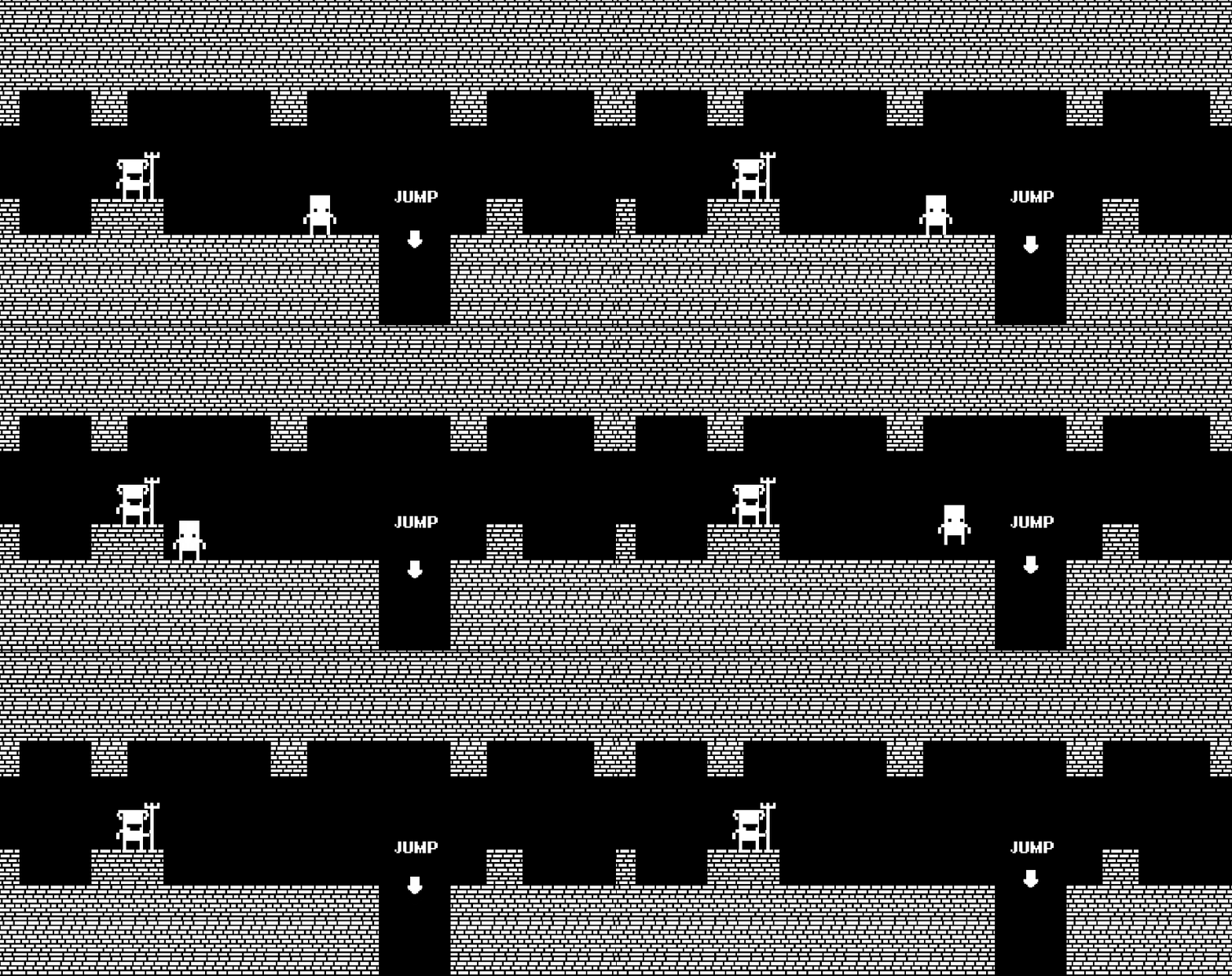
Well, I was tired of looking at that little Atari-era pixel dude, and I made a brand new player sprite. I loved how it came out, so I got excited and drew the game’s first demon as well:

PIT is no longer a 1-bit game. I’ll be using these gray colors to simulate depth. This isn’t exactly what I should be spending time on right now, but I couldn’t look at those placeholder characters anymore. I’d like to have a little demo of the game eventually, so I needed some better art. I love this style and I think it leaves room for more clear and distinct animations.

I haven’t put them into Unity just yet, and I probably won’t until I create full sprite sheets for them.

POST #2: OCTOBER 4th 2020

I spent yesterday and today learning how to use the Animator component in Unity. It’s really simple and I found myself enjoying fiddling with the timelines and working on transition parameters, so that’s mostly all this post will cover. Using the pixel art editor program Aseprite, I edited my Player sprite and turned it into more of a sprite sheet with multiple actions on it.

After that I used Unity’s Sprite Editor tool to “slice” this image into 6 separate sprites. This is the most convenient feature of Unity that I’ve discovered so far. Rather than making 6 .png files for each individual frame of an animation, I draw everything on one sheet and Unity splits them into separate images automatically.

So I drew all the frames, stitched them together using the Unity Animator, and then I had to edit my code, in order to tell the game which animations to play depending on what the player does. Through this process I learned about something HUGE; you can use Unity components in your code if you identify them. Then I learned about [SerializeField] and started getting really excited about how deeply you can customize Unity, in order to fit the rules and needs of your specific project. After this, all the future programming that I’m terrified of feels a little less scary.

After all of that excitement and supposed triumph, it didn’t work. My character was endlessly trapped in a jumping position regardless of whether or not they were in the air. I guess you could call this the first ever bug-fix of my career. I searched my code endlessly yesterday, but I decided to give up for the night. I went on Reddit, watched YouTube videos, went on Unity Learn, and ultimately realized that the code I wrote for character movement and collision was pretty weird and overly complex.

Today I completely rewrote my movement code, and not only is it more concise, it also feels smoother. I can easily edit the speed at which my character moves and their jump height. I also programmed in a double-jump, but I’m not sure if I’ll use it. After that, I programmed in the animations, crossed my fingers, and:

It actually works! If I wanted, I could be completely done with this character right now, but I have way bigger plans for him. I’m really excited to have climbed this wall, and I feel like animation will be a breeze for me compared to the other aspects of the game.

I think next I will try to bring our friend The Guard to life. I want him to start walking towards the player after two seconds with his spear forward. If the player touches the spear they die. This will teach me how to implement player death, and enemy AI!

POST #1: OCTOBER 2nd, 2020

Here’s the first ever post about my game, PIT. This will be a long journey. As I teach myself C# coding, learn Unity Game Engine, start winging-it on game design, and dive into the medium of pixel art, this page will be proof of my struggle.

Since this is my first project, I want to keep things simple, but I’ve set up a few challenges for myself to make this real. First of all, everything in the game needs to come from me. That means I do everything. All the code, art, animation, music and sound effects come from me. Easier said than done. My next little challenge is to tackle all the basic mechanics of video games. I have to add the essentials like; health, enemies, combat, items, HUD & a boss. Lastly, my final challenge is simply the fact that I’m working on my ASUS gaming laptop from 2011 that turns off if you unplug it. It takes me about 8 minutes to open Unity every day! 🙂

Here I’ll explain my general concept for the game. In PIT, you play as a prisoner who is forced into The Pit, a dungeon filled with demons and other terrible things. You will most likely survive the fall, and be forced to fight for survival through the hellish caverns below. The game will be an action platformer with controls very similar to Zelda II.

For my first game, there’s no way I’ll be able to make a massive open world, or a storyline that lasts multiple hours. Why not just make one level and see where it takes me? Then I had a thought, what if my entire game was just one level? What if that one level was completely packed with secrets, alternate paths, and hidden rooms? A game like this could have very high replay-value, and it would be enjoyable for the player to discover new things on their own.

This image has an empty alt attribute; its file name is first-concept-shot.png

Take this starting room for example, it’s currently all I have so far. The character on the right is the player, and the character with the spear is a guard. When the game begins, the player is instructed to jump into The Pit. Most players will simply follow the instruction and jump in without a second thought. However, here’s where the secrets would come in. If the player hesitates, maybe the guard gets mad and pushes you in! I think including alternate scenarios like this that play out without the player expecting them, will make the game feel very alive. I hope this mechanic will also motivate the player to inspect the game more closely. When the player knows there are secrets around, they won’t mindlessly charge through the game.

These “scenarios” as I’ve been calling them, could seriously impact gameplay. In PIT, the player starts without a weapon, they can knock enemies away with a punch, but cannot deal damage directly. So, if you just jump in right away, you will enter The Pit unarmed. However, for one of the secrets in the starting room, I want to include a way to knock the guard into The Pit instead and steal his weapon. Now you can enter The Pit with a starting weapon! An experimental and curious player will be rewarded through scenarios like this.

I plan to get extremely creative and weird with these scenarios. I want to use them in many different ways to constantly surprise and confuse the player. Here’s a few ideas that I love, but seriously who knows if I can program this stuff:

  • Hidden human NPCs who have lost their minds in The Pit, they give you items, info, or just say creepy things to you.
  • If you speak to three insane people, you go insane, some enemies will not attack you.
  • Potentially I might make it so the player dies and restarts when they land inside The Pit, should they have to perform an action in order to survive the fall each time they start the game? I don’t have a reason to include this other than it being funny and unforgiving. Everyone will die on their first playthrough.
  • I plan to seriously hide three horned skulls around the game. If the player finds all three of them in one playthrough, they will transform into a demon themselves, able to fly and shoot.

In terms of programming, I have only created a basic movement script and collision bodies. These allow the player to walk, jump, and bump into walls/ground. I have completed all the frames for the player’s movement animations, and will be importing them into Unity as my next step.

MAC DEMARCO – Salad Days

Captured Tracks

What more can be said about Mac DeMarco? This 29 year old Canadian goofball has shaken the indie sphere from the comfort of his own home throughout the last decade. The album that enlisted so many new fans to his loyal army is still just as relevant in 2020.

Mac began recording music in 2009 under the name “Makeout Videotape” until his EP Rock and Roll Night Club was released under his current name in 2012. His latest release was 2019’s Here Comes the Cowboy, a more folk inspired take on his sound.

In 2014, he released Salad Days, the album that cemented DeMarco as the face of teenage boredom. The feeling of sitting at home all day, thinking about progressing in life and never actually getting up and doing it. The concept of comfort zones and the failure to experiment. All of these topics are intensely dissected through Mac’s groovy and intimate style. The woozy and relaxing aura of the music surrounding you constantly fights back against the nervous lyrics feeling your head.

In contrast to his chill and casual appearance, Mac conveys some pretty anxious and tense emotions through this album. The project was recorded in his apartment after a long tour, and Mac had recently moved from Canada to Brooklyn. Unsure of where life was taking him, he recorded this music to share his feelings of monotony and isolation.

A perfect example of the introverted voice behind this album is present in the track “Blue Boy.” This fun beachy track has a sort of teasing tone to it. As Mac calls out the “blue boy” who is “worried ‘bout the world’s eyes” and “worried ‘bout his haircut.” DeMarco questions the importance of what others really think about you or how you look. He does so in a friendly and soothing manner, his messages are never a lecture, but rather a friendly word of advice.

Most tracks on Salad Days behave in this manner; relaxing and fun music that distracts you from the reality check you’re currently receiving. It’s as if Mac was trying to keep his same old funky sound, while diving into some more intimate and personal topics.

Not all the instrumentation is bright and sunny, however. The track “Chamber of Reflection” is an incredibly introspective meditation on growth and changing as a person. The song asks you to reflect on your surroundings and prepare for the inevitable growth you will undergo. The track opens with “spend some time away, getting ready for the day you’re born again.” The powerful words are accompanied by a piano melody originally composed by Shigeo Sekito in 1975.

If anything, that little fact should tell you that Mac DeMarco is a true crate digger. The man enjoys the obscure and bizarre. Always experimenting and branching out, Mac surely turns down some unique paths of inspiration. A quick YouTube search will show you the wonderfully whimsical life of Mac. He’s a collector of music, old movies, ancient video games, and more.

To this day, Mac enjoys collecting things, smoking cigarettes, and playing music with his friends. For a kid who writes music about growing up, I don’t think he will ever change. Perhaps the societal anxieties he felt on Salad Days have passed, and he understands his place in the world. Now in 2020, we can see Salad Days as a message from the ghost of Mac DeMarco’s teenage past. The fears he felt back then are gone, he currently records music from the comfort of his home and does exactly what he loves the most.

Salad Days should inspire us to find a comfortable spot to reflect, just as Mac did in his Brooklyn apartment. The album shows us that it’s possible to grow up in your own way on your own time. Now, what will come from your “chamber of reflection?”

As a bonus, here’s a funny story about Mac. On his 2015 Another One EP on the final track titled, “My House by the Water,” Mac gave out his full New York address in the last few seconds of the album. He throws in “stop on by, I’ll make you a cup of coffee.” Mac knew it wouldn’t go unnoticed, but sure enough, crowds of kids were showing up outside his house every hour of the day. To no one’s surprise, he was totally chill about it.